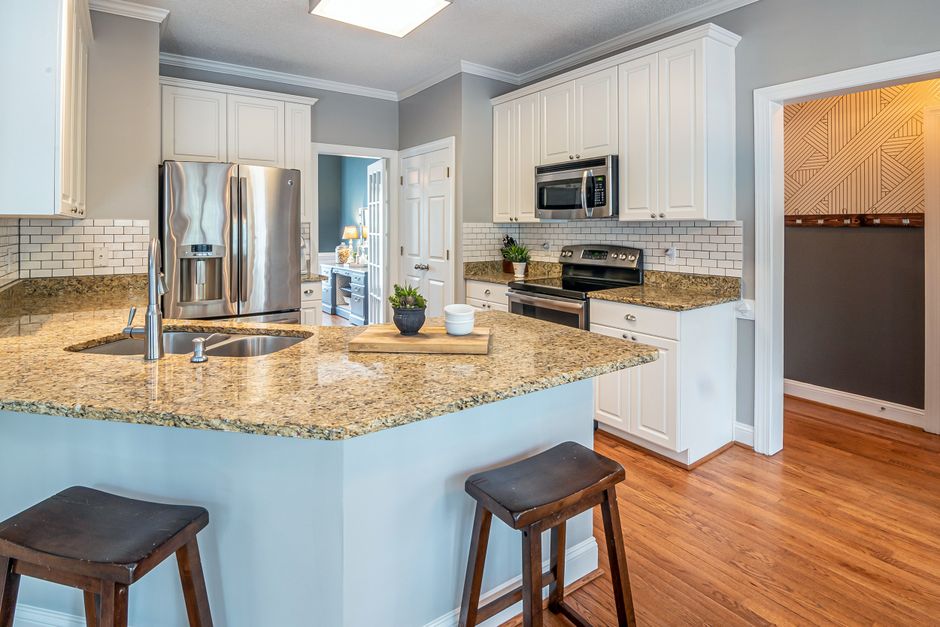
Most older Buncombe County kitchens can carry a heavy stone or quartz top, but only after the cabinet boxes, the floor beneath them, and the delivery path from the street all check out. Get those three things right and a rigid slab will sit on the kitchen for decades; get one of them wrong and the same slab can crack at a seam, sag over a dishwasher, or never make it through the back door. The material choice matters too, because humid mountain summers and wood-stove winters treat granite, quartz, marble, and wood very differently.
Start with the cabinets, not the stone
Natural stone and engineered quartz slabs weigh far more than the laminate or butcher block tops they replace, so once the new surface is set, the cabinets and the floor under them carry that load every day.
Lay a long level across the cabinet tops, front to back and then side to side. Cabinets should be shimmed level and flat at the cabinet itself. Do not count on the installer to correct a crooked run later with thick shims jammed under the stone; that approach leaves the top unsupported in spots and shows up as uneven gaps at the edges.
Base cabinets should be screwed to wall studs and fastened to each other so the run behaves as one structure. Loose or freestanding boxes let the top flex, and flex is what cracks stone at its weakest points, usually near a cutout.
Open the sink base next. Look for swollen particleboard, water stains, a soft floor under the box, or a mildew smell. Humid mountain summers and slow plumbing leaks quietly degrade cabinet boxes over the years, and stone cannot be set safely on a weakened box. If the box under the sink is soft, rebuild or replace it before anyone measures for the slab.
If the house sits in Swannanoa, along the French Broad, or anywhere in the county that took water in the 2024 flooding, have the cabinet boxes and the subfloor checked for hidden moisture damage and mold before new tops are installed. Water damage can hide inside a box that looks perfectly fine from the outside.
The floor under the counters
Many older homes in Asheville neighborhoods such as Montford and West Asheville sit over crawlspaces on sloped lots, and floors that felt solid under laminate can tell a different story under stone. Stand near the sink or the dishwasher and feel for bounce or a soft spot in the floor. Either one can point to sagging joists, and a rigid slab set on a moving floor is a crack waiting to happen. Any floor movement should be addressed before the top goes on, not discovered after the first crack.
Templating comes last, and nothing moves after it
Templating happens after the cabinets are final. The fabricator captures the exact footprint of the counters and cuts the slab to match, so do not move, replace, or reshim any cabinet after the template is made. A box nudged half an inch after templating turns into a visible gap at the wall or a stone edge floating over nothing.
Have the sink, faucet, and cooktop on hand at templating, or their exact spec sheets if they are not installed yet. Cutouts and faucet holes are cut correctly the first time only when the real dimensions are in front of the fabricator. Buying a fixture after templating that does not match the cutouts is an expensive way to learn that rule.
Ask to see the seam layout before fabrication begins. Seams placed through a sink or cooktop cutout, or across an unsupported span, are the seams most likely to crack or open over time. A layout that keeps seams away from cutouts and over supported structure is worth a conversation before the saw starts.
Ask the fabricator for the unsupported overhang limit for the material and thickness you have chosen. Island and bar overhangs beyond that limit need steel brackets or corbels, and a thicker slab does not change the physics of a long span.
Undermount sinks hang from the underside of the stone, so they need proper clips or brackets and adhesive rated for the job. A sagging undermount sink usually means failed attachment, not failed stone. Dishwashers should be fastened to the side cabinets, never screwed into the underside of a stone top, because screws into stone can chip or crack it.
What the fabricator should handle
Cutting engineered stone or granite produces fine crystalline silica dust that is harmful to breathe. Fabrication should be done wet, with dust control, at the shop. Do not cut or grind a slab yourself, and treat on-site trimming as shop work wherever possible.
Old plaster and framed walls are rarely straight in an older house. Expect the back edge of the top to be scribed to the wall, or the gap filled with caulk or covered by a backsplash, rather than fitting tight everywhere. That is normal work on an old house, not a sloppy install.
The delivery path matters as much as the cabinets
Hillside homes around the county often have steep driveways, long walks, or narrow stairs. Slabs are carried on edge by a crew, so measure the delivery path and every doorway between the truck and the sink wall, and clear it before install day. A tight turn in a narrow mountain hallway can force a seam that would not otherwise exist, which is far better to learn during planning than during the carry.
Before the old tops come off, confirm the sink and dishwasher shutoff valves actually work. Older homes often have stuck or corroded valves, and the day the counter is out is the cheapest day to replace them.
Which material suits a humid mountain kitchen
Granite and other natural stone
Granite handles mountain humidity without complaint, but its sealing needs vary by slab. Test it by leaving a few drops of water on the surface. If the spot darkens within a few minutes, the stone needs sealing. Retest periodically instead of resealing on a fixed calendar, because some slabs go a long time between applications and others need attention sooner.
Clean polished stone with a pH neutral cleaner. Bleach, vinegar, and abrasive powders dull the finish and wear down sealer, which is the opposite of what a low-maintenance kitchen needs.
Engineered quartz
Quartz is never sealed, and its resin binder is the reason hot pans can scorch or discolor the surface, so trivets belong next to the cooktop. Strong direct sun can fade it as well, which matters in a kitchen with a big sunny window bank or on an outdoor counter. It rewards the homeowner by needing no sealer and only mild cleaning.
Marble and other calcite stones
Marble etches from acids such as lemon juice, vinegar, wine, and tomato. Sealing slows staining but does not stop etching, so a bright marble island in a busy kitchen will show marks no matter how carefully it is sealed. Some homeowners accept that patina as part of the house; others keep marble to a baking station and run granite or quartz on the main run.
Butcher block
Wood moves with humidity. Muggy summers swell a butcher block top and dry wood-stove heated winters shrink it, so it must be fastened with slotted holes or clips that allow movement and kept oiled or finished, especially around the sink. Wood can live near a sink when it is finished and maintained; what it cannot do is behave like stone and stay perfectly still.
Matching the material to the house
A house with humid summers, dry stove heat, bright window light, and a busy cook at the stove asks a lot of any surface. Granite or quartz handles the main run around the sink and cooktop in most mountain kitchens, while wood suits a bar top or a baking area where its movement and maintenance are easier to live with. Marble suits a homeowner who wants the look and accepts the patina. Choose by how the surface will be used and where it will sit in the light, not by which material sounds toughest.
After the top is in
Inspect the silicone caulk at the sink rim and backsplash once a year. When it cracks or pulls away, recaulk to keep water out of the cabinet below, which is the same box you checked so carefully before the slab ever arrived. A yearly caulk check, the water-drop test on stone, and trivets under every hot pan are the habits that keep a heavy top sitting straight for years on a kitchen that was made ready.